



Academy Building Renovations + Updates
Since the Salisbury Association made the Academy Building its home in 1991, members and local craftsmen have worked to preserve the building’s historic character while adapting it for contemporary use. This page chronicles the major renovations and recent projects that keep the 1833 structure central to community life.
Remimagining the Academy Building, 2024 – 2025
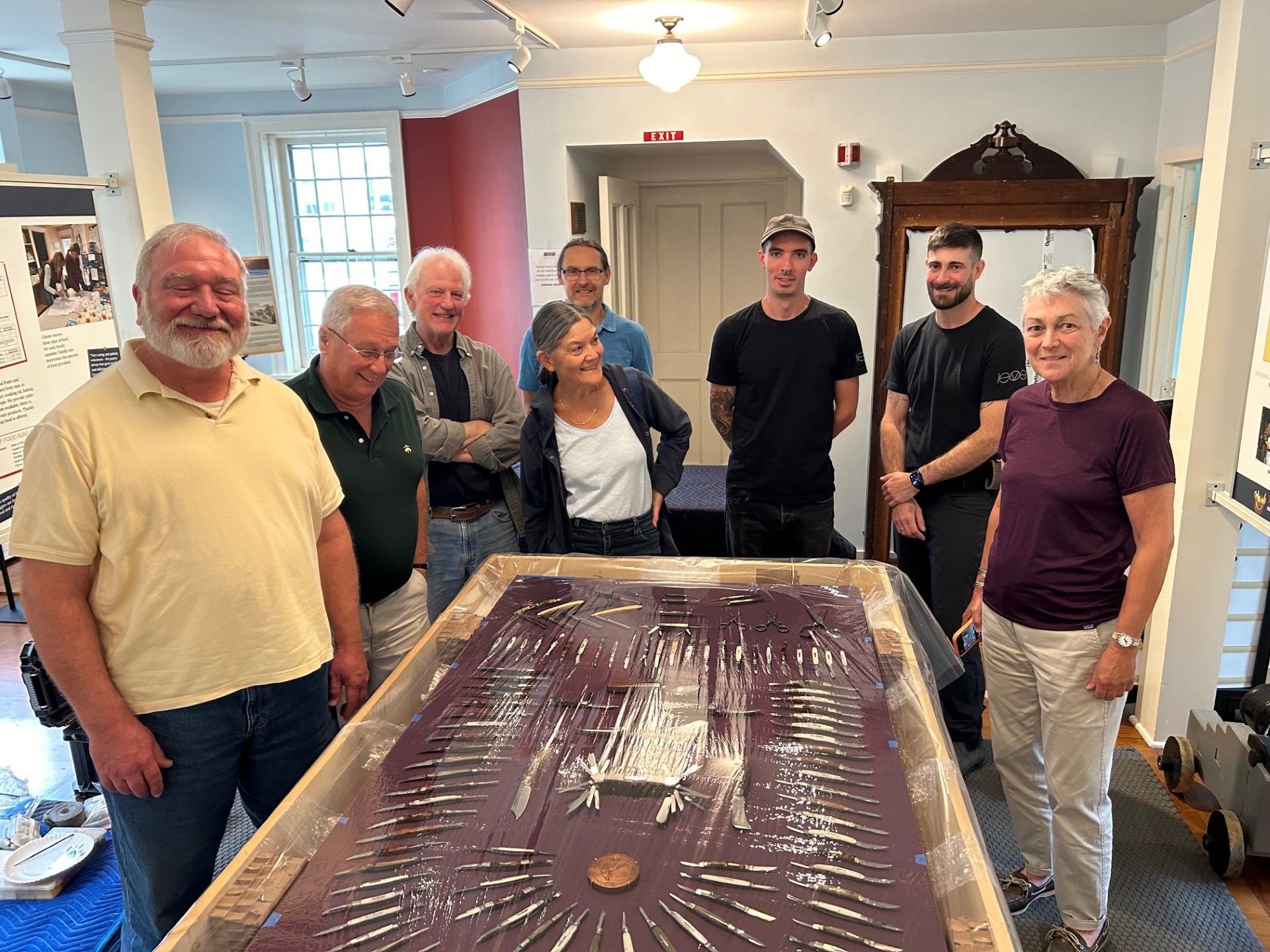
In late summer 2024, after a nearly two-year conservation process, the Holley pocketknife collection in its, refurbished black walnut display case, was ready to return to the Academy Building. But no one wanted to return it to its former home in an obscure corner.
At the same time, the Salisbury Association Land Trust was looking for a location to display the Salisbury Open Space Map and offer trail maps and brochures to visitors.
It was time to rethink and refresh the building’s first floor exhibit space.
The Salisbury Association engaged Chris Pouler, a designer of exhibits and television news sets, to redesign its exhibit space to enhance use of the building and provide a more cohesive arrangement of the Association’s historical artifacts, paintings and interpretive texts. Pouler created four new exhibition focus areas: Arsenal of the Revolution, Holley Manufacturing Company (including the pocketknife display), Land Trust and Industry in Salisbury.
The newly designed exhibits also allowed more space for the Coffing family portraits and prominently displayed the intriguing story of Jane (Jennie) Winslow, a free Black woman whose image appears in the Maria Birch Coffing portrait.
In addition to Pouler, several local craftspeople provided valuable services:
- James Clark (graphics layouts)
- Duane Jones (a new wall)
- Mark and Matt Shaggy (construction of wall panels)
- Carrie Babigian (custom fabrication of cherry display rack)
- Cory Wiggins (painting)
- Ghi Sign (printing and application of graphics and text panels)


Conservation of the Holley Centennial Knife Collection, 2023 – 2024
The Holley Manufacturing Company, founded in 1844 by Alexander Hamilton Holley, was the first domestic maker of pocket cutlery in the United States. The company was a major employer in Lakeville for more than 100 years. A display of Holley knives was created for the 1876 Centennial Exposition in Philadelphia and housed in a black walnut and glass-covered case. In 2023-24, the knives were cleaned and repaired and the historic case refurbished. The display, which had been modified several times in its history, due to theft and other factors, was redesigned and more than one hundred of the original pocket knives are included. Fallon & Wilkinson of Baltic, CT was chosen to do the work, which required each of the 130 knives to be assessed and treated individually. The case was also repaired and the lettering regilded. Level Fine Arts Service of Bolton, CT created a new display arrangement according to museum quality standards. The newly preserved and resigned display is now housed prominently in reconfigured Academy Building space.
New Doors and Banner Hardware, 2020
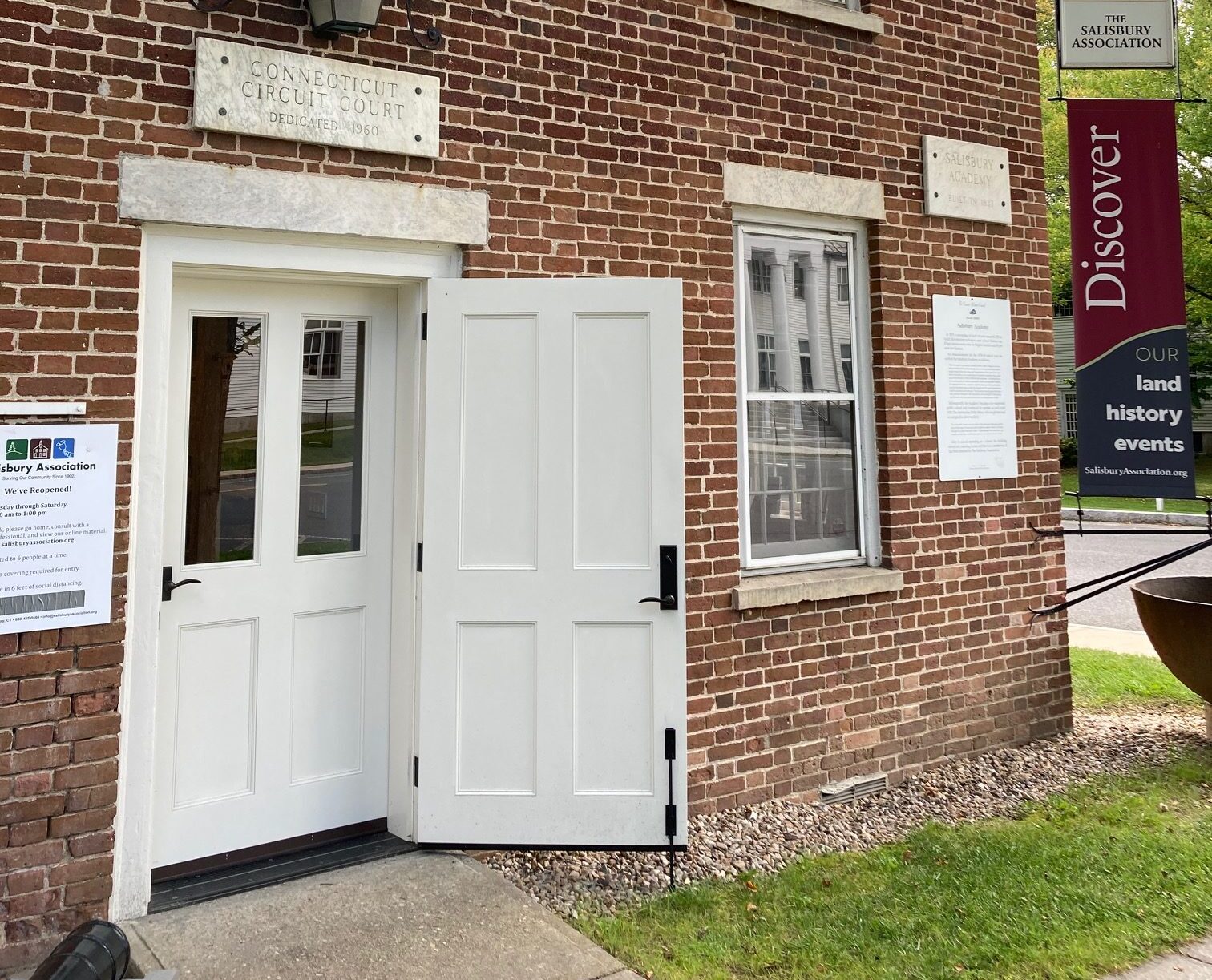
When the Association needed to replace inappropriate entrance doors and add a new banner to the Academy Building exterior that would be in keeping with its historical purpose and era, we were fortunate to find local craftsmen of exceptional skill to help us.
Bert Fitch, a master woodworker, made three exterior doors for the Association in 2020. Chris Brennan created a historically appropriate design, typical of a 19th-century academy, and Bert used historic methods, mortise-and-tenon joints, to bring the design to life. He also generously donated much of the labor required to fabricate the doors.
William Trowbridge
William Trowbridge, a master ironworker, made hand-forged hardware for the Salisbury sign installed many years ago. When asked to help us with a new banner for the building, he forged matching hardware and devised a special system for making adjustments. William gifted the handsome hardware that allows us to hang a modern banner that still seems appropriate for the historic building.


Meeting Table, 2013
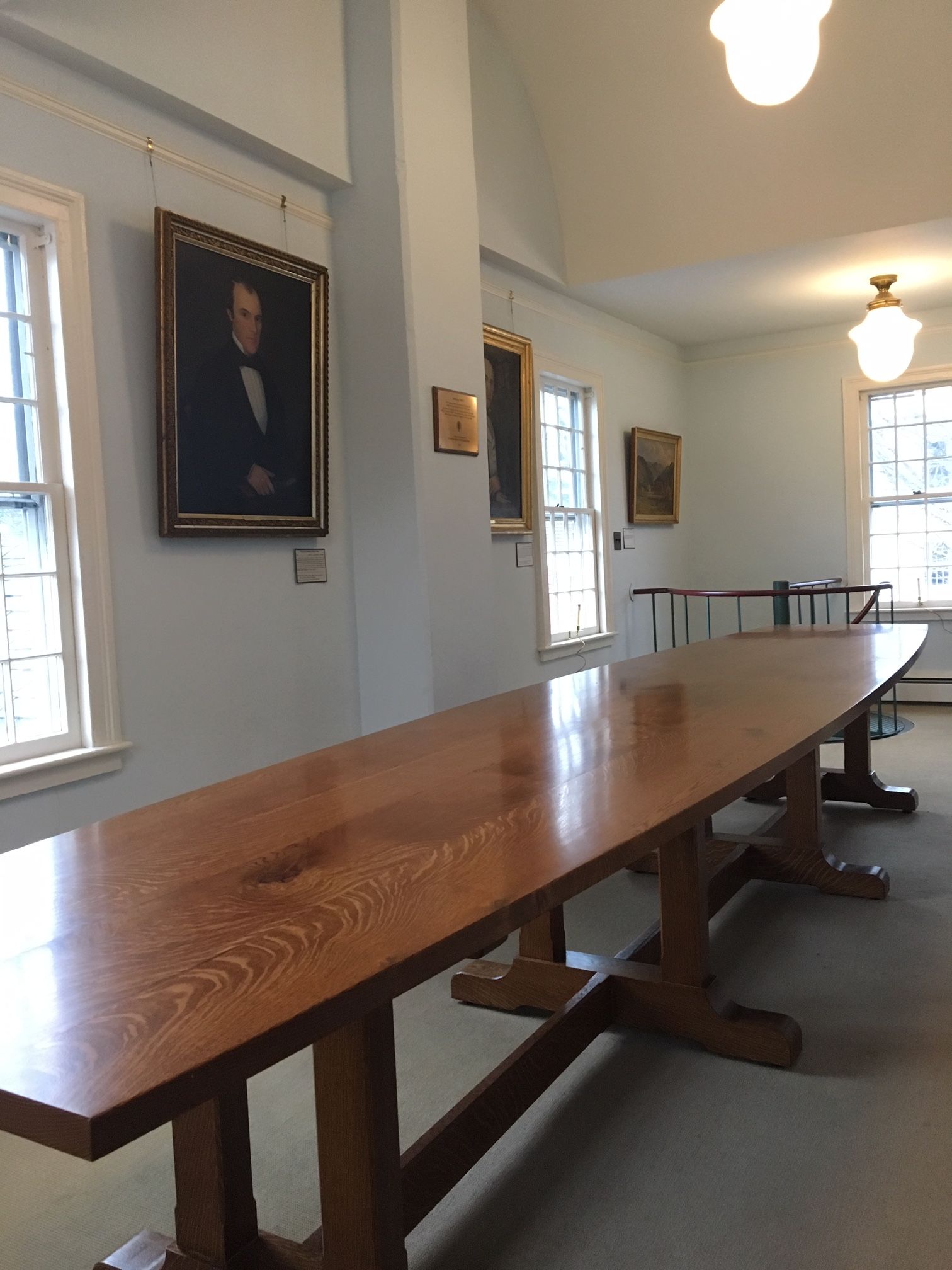
A magnificent 300-year-old white oak tree at the Town Grove blew down during a storm in 2010. Inspired to make use of the wood, the Association commissioned David Bowen, a master woodworker at the Salisbury Artisans, to design and make a 16-foot meeting table. Elaine and Louis Hecht funded the project. Ed Herrington donated use of his company’s lift to help town crews move the tabletop into the building.

Major Renovation, 2011
When the Holley-Williams House was sold in 2010, many museum artifacts were moved into the Academy Building. Renovation of the interior space became a priority because of severe overcrowding. In 2011, Chris Brennan, a trustee and interior designer specializing in historic preservation, designed and oversaw a two-year renovation project. The first floor reception area, computer room, and restroom were updated, and the exhibit space was upgraded with an inventive system for displays. David and Bobbie Olsen and their Family Foundation generously funded the extensive renovations.
Circuit Court fixtures on the second level were replaced with wooden storage cabinets designed to meet our specific needs and those of our collections. With appreciation for Bobbie’s many contributions, both in connection with the renovation project and as a long-time trustee, the second-floor space was named The Bobbie Olsen Room in her honor.

The Academy Building: Bobbie Olsen Room